
Mackie M. Jalloh: Sierra Leone Telegraph: 22 October 2025:
In the decaying heart of Freetown — from the swampy shacks of Kroo Bay to the rusted outskirts of Kissy— a slow and deadly war is unfolding. It is not a war of politics or religion, but of addiction and despair. Its weapon is a synthetic drug known as Kush, and its casualties are Sierra Leone’s young men and women, reduced to hollow shells of who they once were. (Photo above: Courtesy of RFI).
Kush looks like marijuana but is far deadlier. Experts say it can be 25 times stronger than fentanyl, a potency that has earned it the nickname “the zombie drug.”
Across Sierra Leone, this synthetic poison is creating an underworld in plain sight — turning classrooms, markets, and alleyways into open drug dens.
“I keep smoking it because it makes me forget about my worries and challenges,” says Memunatu, a 24-year-old woman from Kroo Bay, heavily pregnant with her second child. “It’s a temporary escape… but with a brutal come down.” Her eyes are sunken, her hands tremble, and her voice carries the weight of hopelessness. She wants to quit but cannot. “As long as I’m here, I’ll keep smoking it,” she admits.
The den where Memunatu lives is a haunting picture of decay — thin mats, rotten boards, and the stench of infection. Around her, teenagers and adults lie motionless, some with open sores that refuse to heal. Saidu, barely 17, pulls up his trousers to reveal gaping wounds on his legs. “Look at me,” he says softly. “Just because of this drug, I have sores on my feet. This drug brings destruction.”
A few meters away, 14-year-old Kadiatu sits in a corner, her legs twisted and swollen. She started smoking Kush at 12. Now, she cannot walk. “They have to wash her wounds every day,” says a local volunteer. “She cries when they clean it, but when the pain eases, she asks for more Kush.”
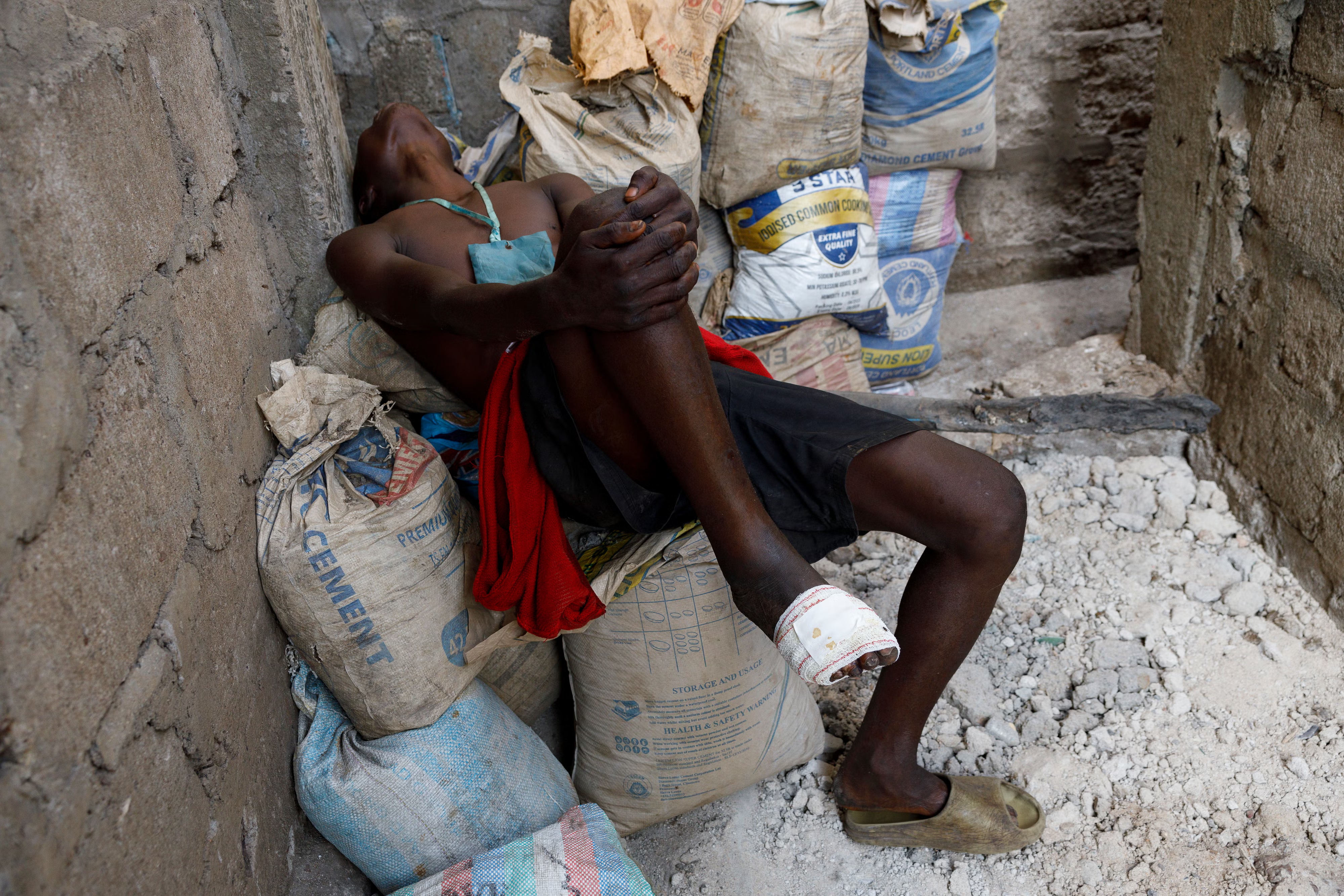
These are not the fringes of society — they are its broken center. In Freetown’s Kroo Bay, drug dens have appeared under bridges and behind schools. In Kissy, addicts live beneath the same roads that carry government convoys to and from various offices. Their cries for help echo beneath the city’s noise. “All we are saying is, we need help,” one man pleads. “Look at our condition. We are dying slowly.”
Yet despite the visible decay, the government of Sierra Leone remains largely silent. While officials issue press releases and hold “stakeholder dialogues,” little is being done to confront the reality on the ground.
There are no functioning rehabilitation centers, no sustained education campaigns, and no serious crackdown on those who import, produce, or distribute the drug.
Behind the silence lies suspicion. Investigations and whispers among local residents suggest that some individuals with political or business ties may be profiting from the Kush trade.
Reports of hidden Kush farms, particularly in the northern provinces, have circulated for years, yet few arrests have been made. The alleged complicity of powerful figures — those who shield traffickers and manufacturers — has turned the epidemic into a national scandal shrouded in impunity.
“How can this drug enter every community in Freetown, every town upcountry, and the government say they don’t know who is behind it?” asks a youth activist from Kissy. “Someone is protecting them. Someone is benefiting while our young people die.”
The cost is staggering. Hospitals are overwhelmed with psychotic patients. Families are collapsing. Children are being born into addiction. Sierra Leone, already struggling with poverty and unemployment, now faces a generational catastrophe — one that threatens to undo decades of progress.
Health experts warn that the Kush crisis is no longer just a drug problem, but a humanitarian one. “This is a social collapse happening in slow motion,” says one social worker who has been documenting the epidemic. “We are raising a generation of the walking dead — enslaved not by choice, but by neglect.”
And in the shadows of the city, the cycle continues. Addicts sell scraps, beg for coins, or steal to buy their next smoke. Some die quietly; others vanish. Their bodies are often buried anonymously, their stories untold.
Kush has become a mirror reflecting Sierra Leone’s greatest failure — the failure to protect its youth. Until the government acts decisively, until those who profit from this trade are exposed and punished, the epidemic will continue to rot the country from within.
For now, the cries from Kroo Bay and Kissy remain unanswered — a chilling reminder that Sierra Leone’s future is being burned away, joint by joint, in the cold ashes of Kush.
Growing up, seeing a corpse was something sacred. When someone died in the community, everything stopped as it was a solemn moment. Children were kept away; even catching a glimpse of the body was unthinkable.
Today, in my country, that sense of sanctity is gone. Death has been normalised due to number of factors but primarily and suspiciously drugs use. Corpses lying on our streets have become a disturbing new normal.
This is not right. It strips away the dignity of the dead. Regardless of the circumstances leading to one’s death, there must be some semblance of respect — a proper resting place, not an open street.
The ongoing debate over data on deaths suspected to be linked to kush is deeply unfortunate. As a matter of fact, it’s demeaning.
For a minister to even suggest that the images of dead bodies circulating online are the work of bots shows how callous some in leadership have become. No remorse, no empathy, no humanity. To even demand evidence when an institution reports the number of bodies collected is a slap in the face of our collective humanity especially when we see corpses on our streets almost every day.
Let’s be clear: in one way or another, we are all affected by this epidemic. I have personally seen two relatives fall victim to kush. This is real, not hearsay.
And while the public focuses on kush, let’s not forget the other dangerous drugs including cocaine that continue to find their way into our country.
Need an example? A government envoy to Conakry was recently caught red-handed with cocaine. If not for the foreign minister’s diplomatic intervention, that envoy would be rotting in a Guinean jail today.
At the central government level, we must turn our words into real action. I appreciate the ongoing efforts, but this is the time to go deeper, to trace the sources, expose the networks, and confront this crisis head-on.
Our commitment to human capital development is being severely undermined by the growing number of young people consumed by drug addiction.
No matter what achievements this government may wish to highlight, the persistent failure to decisively address the drug crisis will continue to overshadow and discredit those gains.
This issue goes beyond the present moment or the image of our country; it strikes at the heart of our collective future. If we keep losing our young people to drugs, we are eroding the very foundation of tomorrow’s progress.
A stitch in time, they say, saves nine. The time to act is now.
When the 2023 elections were stolen, one area that couldn’t be manipulated was the municipal results. Why? Because the candidate, Yvonne Aki-Sawyerr, understood the power of data. She collected it meticulously, safeguarded it fiercely, and released it strategically. Her preparation, precision, and belief in evidence made it impossible for anyone to distort the truth.
Her Transform Freetown – Transforming Lives development roadmap is another clear demonstration of her commitment to evidence-based leadership. Every initiative under this vision; from improving urban infrastructure and waste management, water for residents to pushing climate resilient policies and solution, are all informed by carefully collected and analyzed data.
Today, in the ongoing fight against the kush epidemic, that same data-driven discipline is once again on display. Faced with an escalating national crisis that has claimed young lives across Sierra Leone, the central government through the Ministry of Local Government has responded not with solutions, but with intimidation.
A long, bureaucratic letter demanding data from the Freetown City Council was meant to corner the Mayor. Instead, Yvonne delivered, presenting concrete data that exposes the grim reality of kush-related deaths in the city.
Her response did more than provide numbers; it revealed the uncomfortable truth that the authorities would rather ignore. Instead of focusing their energy on stopping the importation and distribution of these deadly substances, they have chosen to question the messenger.
The Ministry’s reaction betrays not leadership, but fear, fear of facts, fear of accountability, and fear of a woman who continues to lead with integrity and evidence.
Mayor Aki-Sawyerr’s example shows that data is not just a tool for governance; it is a shield against misinformation, manipulation, and political bullying.